Every year, millions of dogs suffer in silence. Not because their owners don’t care — but because dogs are biologically hardwired to hide pain. It’s an evolutionary survival mechanism: in the wild, showing weakness invites predators. In your living room, it means your golden retriever limps through breakfast and you have no idea he rated a 6 on the pain scale overnight.
This is the problem Perfect Paw was built to solve. And it starts with understanding how veterinary professionals measure pain.
The 0–10 Canine Pain Index #
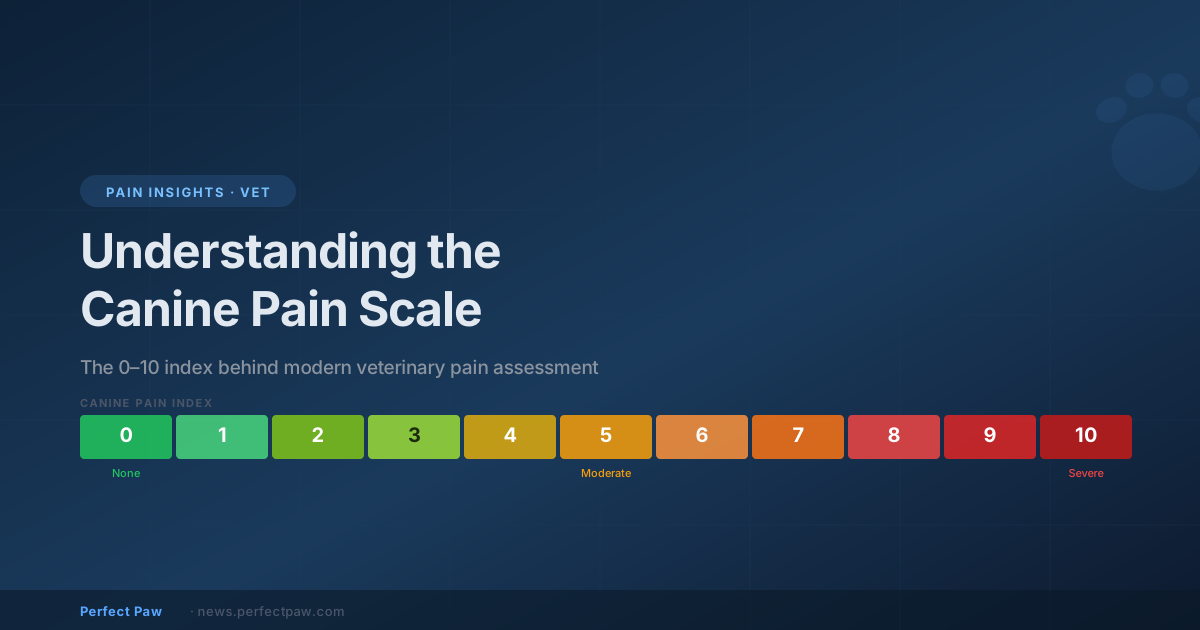
The most widely used pain assessment tool in veterinary medicine is a composite scoring system that rates pain on a scale from 0 to 10. While several validated scales exist — including the Glasgow Composite Measure Pain Scale (CMPS-SF) and the Colorado State University (CSU) Canine Acute Pain Scale — the numerical 0–10 format is the lingua franca of clinical practice.
Here’s how the levels break down:
Why Dogs Hide Pain #
The trickiest part of canine pain assessment is that the most stoic patients are often in the most pain. Working breeds — Labradors, German Shepherds, Border Collies — are notorious for tolerating discomfort far beyond what most humans would endure. A study published in the Veterinary Anaesthesia and Analgesia journal found that owner-reported pain detection rates were accurate in fewer than 40% of confirmed moderate-pain cases.
Translation: pet owners miss pain more than half the time, even when they’re paying close attention.
The behavioral signs most commonly overlooked include:
- Postural changes — a subtle shift in weight distribution when standing
- Facial tension — the “pain face” in dogs involves ears pulled back, orbital tightening, and a subtle raising of the cheeks (documented in the Dog Grimace Scale)
- Altered sleep patterns — restlessness, frequent repositioning, and reduced deep sleep
- Activity avoidance — not the dramatic “won’t walk” limping, but a quiet preference for lying down, avoiding stairs, or hesitating before jumping
How The Ruff Captures What Eyes Miss #
The Ruff’s sensor array captures over 300 data points per second across six physiological and biomechanical dimensions:
- Accelerometry — detects gait irregularities, asymmetries, and subtle load-bearing changes imperceptible to human observation
- Heart rate variability (HRV) — pain consistently reduces HRV; the pattern is measurable within minutes of onset
- Respiratory rate and pattern — shallow, rapid breathing is a reliable marker across mammalian pain studies
- Core temperature fluctuation — localized inflammation produces characteristic thermal signatures
- Vocal event detection — classifies vocalizations including whimpers, yelps, and altered bark patterns
- Behavioral inactivity patterns — distinguishes restorative rest from pain-induced stillness using time-series analysis
The AI model combining these signals was trained on 24,000+ hours of labeled veterinary data, reviewed and annotated by certified pain specialists. The result is a continuous pain score — updated every 15 minutes — that correlates with clinical assessment at 87% accuracy across a validation cohort of 412 dogs.
Interpreting Your Dog’s Score #
When you open the Perfect Paw app and see a pain score for your dog, here’s how to act on it:
| Score Range | Category | Recommended Action |
|---|---|---|
| 0–2 | None to Minimal | No intervention needed. Continue monitoring. |
| 3–4 | Mild | Monitor closely. Note any behavioral changes. Contact your vet if sustained. |
| 5–6 | Moderate | Schedule a veterinary visit within 24–48 hours. |
| 7–8 | Significant | Same-day veterinary contact recommended. |
| 9–10 | Severe | Emergency veterinary care. Do not delay. |
If your dog scores 9–10: This is a veterinary emergency. Contact your veterinarian immediately or go to the nearest emergency animal hospital. In the US, you can call the ASPCA Animal Poison Control Center at (888) 426-4435 for toxicity-related emergencies, or locate a 24-hour emergency vet at VECCS Emergency Hospital Finder. Do not wait to see if symptoms improve — severe pain in dogs can indicate life-threatening conditions including GDV (bloat), internal bleeding, or spinal compromise.
The score is a tool, not a diagnosis. It tells you when to seek help — but the cause, and the treatment, require your veterinary team.
A Note on Chronic Pain #
Acute pain — from an injury or surgery — is relatively straightforward to identify and treat. Chronic pain, particularly from degenerative conditions like osteoarthritis (which affects an estimated 20% of adult dogs), is far more insidious.
Chronic pain modifies behavior gradually, over weeks or months, in ways that are easy to attribute to “slowing down with age.” Reduced willingness to play, stiffness after rest, reluctance to climb stairs — these are pain signals, not inevitable aging. The Ruff’s trend analysis is specifically designed to catch gradual-onset chronic pain by tracking week-over-week changes in pain scores and flagging patterns that warrant veterinary evaluation.
A Note for Multi-Pet Households #
This pain scale and The Ruff’s monitoring system are designed specifically for dogs. If you also share your home with cats, it’s important to understand that feline pain expression is fundamentally different. Cats are even more adept at masking pain than dogs, and their behavioral indicators — such as the Feline Grimace Scale — involve distinct facial action units (ear position, muzzle tension, whisker orientation) that don’t map to canine signals. Applying a canine pain framework to a cat can lead to both false reassurance and unnecessary alarm. If you suspect your cat is in pain, consult your veterinarian and ask about feline-specific assessment tools.
Your dog is always communicating. The Ruff makes sure you can hear them.
Dr. Sarah Mitchell consults for Perfect Paw on veterinary pain assessment and AI training data quality. She practices at a veterinary pain management center in Boston, MA.